When families first begin exploring Montessori education, they often come across two very different myths.
On one hand, you may have heard that Montessori classrooms are completely unstructured, where children run around doing whatever they please, and it is "all play and no work." On the other hand, you might have heard the exact opposite: that our environments are so rigid and quiet that they stifle creativity and natural childhood joy.
So, what is it really like inside a Montessori classroom?
The truth is that a high-fidelity Montessori classroom is a beautifully balanced environment where freedom and discipline exist hand in hand. While we can describe it on paper, nothing quite compares to stepping inside, taking a seat, and observing the harmony of our classrooms for yourself.
In the meantime, here is a glimpse into what you will see during a typical day at Crabapple Montessori School (CMS).
1. A Purposeful Arrival
From the moment a child steps through our doors in the morning, expectations are thoughtfully set, even for our youngest learners in the Toddler program.
Children are empowered to take care of their own belongings. They hang their bags on low hooks, take off their outdoor coats, and change into special indoor shoes. Changing into indoor footwear serves two distinct purposes: it keeps our environments clean and beautiful, and it signifies to the child that they have entered a calm, comfortable space that belongs to them.
As children enter the classroom, their Guides greet them intentionally. A Guide will lower to the child's eye level, look them in the eye, offer a warm smile, and greet them by name, often accompanied by a polite handshake. By modeling these gracious social interactions daily, we help children internalize grace, courtesy, and respect. Before long, these warm greetings become second nature both inside and outside of school.
2. The Uninterrupted Work Period
A hallmark of authentic Montessori education is the uninterrupted work cycle. We recognize that deep concentration requires time to unfold. Rather than chopping the morning into short 30-minute subject blocks, we honor children’s natural focus by providing a sustained block of time each morning.
- For Toddlers: The work cycle is appropriately adapted to align with their developmental stamina.
- For Primary students (ages 3–6): The morning work period is typically up to three hours long.
- For Elementary students: A substantial morning work period is complemented by a second focused work block in the afternoon.
During this time, children select work from carefully prepared shelves, while Guides deliver targeted individual or small-group lessons.
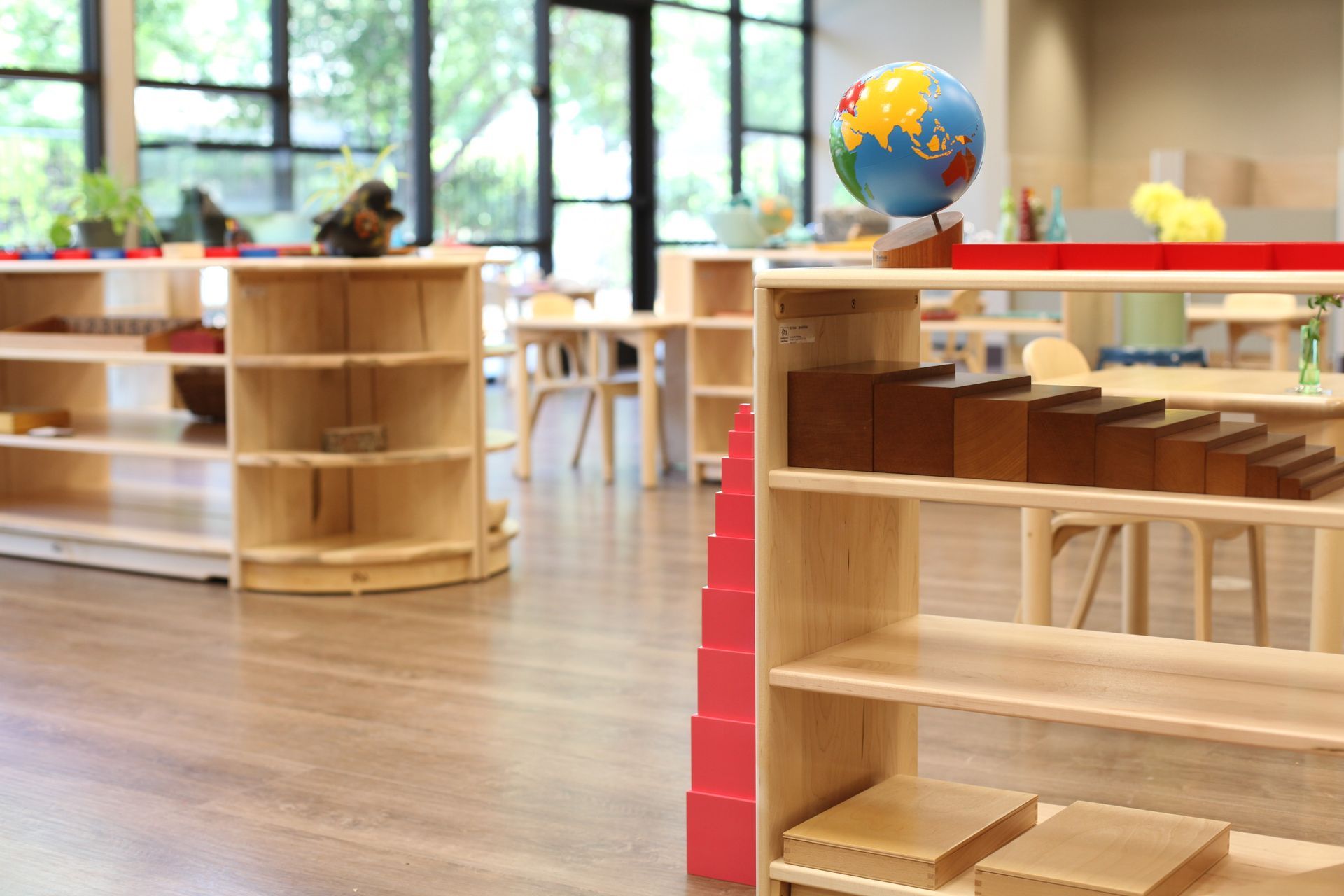
To an outside observer, a child might look like they are simply playing with colorful wooden blocks or stringing beads. However, every material in our rooms is scientifically designed with explicit learning outcomes:
- What looks like a simple puzzle is actually a hands-on exercise in botany or geography.
- What looks like a string of glass beads is a tactile tool for exploring concrete math concepts, such as squaring and cubing numbers.
Freedom Within Limits
During the work cycle, children enjoy freedom of movement and choice. Within clear boundaries, they may choose:
- Where to work (at a table or on a work rug on the floor).
- Whether to work independently or with a peer.
- When to take a quick break to stretch, get a glass of water, or use the restroom without needing explicit adult permission.
Adults value autonomy in their workplaces, and at Crabapple Montessori School, we afford our students that same fundamental respect.
3. Nurturing Social Development & Friendships
Montessori education focuses on developing the whole child: academically, emotionally, and socially.
Because children have choices about where and with whom they work, social development happens organically throughout the day. Guides gently support children in distinguishing between finding a complementary, productive work partner and enjoying a playful social relationship during outdoor play.
As children reach the Elementary years, friendships become central to their developmental drive. Navigating these relationships brings immense joy, as well as the natural, healthy challenge of peer conflict.
Rather than stepping in to immediately manage behavior or impose quick fixes, our Guides use these moments as vital learning opportunities:
- We teach explicit mediation and conflict resolution strategies.
- We conduct grace and courtesy lessons through role-playing and storytelling.
- We empower children to express their feelings, listen to their peers, and find mutually respectful solutions.
4. The Unique Role of the Montessori Guide
Another distinct feature of CMS is the role of our adults. We refer to our educators as Guides rather than teachers because it accurately describes their daily work.
Instead of standing at the front of a room lecturing to a passive group, a Guide prepares the environment, observes each child’s developmental needs, and opens doors to discovery.
- In Primary: Lessons are predominantly given one-on-one, honoring each child's individual pace and learning style.
- In Elementary: Lessons transition to small groups, satisfying the child's natural desire for peer collaboration.
One of the most refined skills of a Montessori Guide is knowing when to offer help and when to step back. We hold immense trust in children's capabilities. When given the time, space, and proper tools to work through a challenge independently, children build genuine resilience, problem-solving skills, and deep-seated confidence.
Throughout the day, Guides actively observe and keep detailed record-keeping notes. These observations inform future lessons, track academic progression, and provide accurate, meaningful insights during parent conferences.
See the Montessori Difference for Yourself
While reading about a Montessori classroom offers a helpful overview, there is no substitute for experiencing the quiet concentration, joy, and independence of our students in person.
We warmly invite you to
visit our campus in Alpharetta, take a guided tour, and observe our classrooms in action.