When choosing an educational path for our children, parents in our Alpharetta community often ask many questions. How does a school align with our family values? What are our primary goals for our children? What life skills do we hope they carry forward beyond their early years?
When parents consider Montessori, independence is usually the first trait that comes to mind. While building independence is foundational to everything we do at Crabapple Montessori School, we talk about it so often that it is worth stepping back to highlight the other traits we actively nurture in our classrooms every day.
Our guides care deeply about academics, as we are naturally curious people fascinated by the world around us. But our commitment goes beyond academics. We want the children in our care to grow into grounded, compassionate, and self-assured individuals who feel good about who they are and care deeply about others.
Here are five core traits we nurture at Crabapple Montessori School.
1. Kindness and Social Harmony
Academics matter, but interpersonal skills form the foundation of a fulfilling life. At CMS, we believe true achievement happens when children learn to collaborate, empathize, and build community.
The structure of our daily routine, including uninterrupted work periods and mixed-age classrooms, provides organic opportunities to practice kindness. Older children mentor younger peers, and younger children learn to observe and respect the work of others.
We teach Grace and Courtesy, a core element of the Montessori curriculum:
- In the Classroom: Guides model how to offer help, speak quietly, wait patiently, and respect a classmate's workspace.
- On the Playground: When conflicts arise, guides step in with real-time coaching rather than swift external judgment. We help children recognize their emotions, express their needs, and listen to others.
- Conflict Resolution: We give children the precise vocabulary to navigate disagreements respectfully, teaching them how to solve problems constructively and honor differences.
2. A Deep, Intrinsic Work Ethic
Traditional educational models often rely on external motivators like grades, gold stars, or public praise. While rewards can drive short-term compliance, they rarely build long-term internal drive.
At Crabapple Montessori School, we focus on intrinsic motivation. We do not use letter grades or competitive ranking systems. Instead:
- Narrative Assessment: Guides track each child’s developmental and academic progress continuously, offering specific narrative feedback that highlights effortless focus and areas for growth.
- Thoughtful Encouragement: Rather than telling a child "Good job," our guides say, "I noticed how long you focused on that long division work today. How did it feel when you finished?"
- Focus on Effort: By emphasizing the process over the product, children learn to take pride in hard work, embrace challenges, and measure success by their own internal growth.
3. Practical and Innovative Creativity
Creativity in a Montessori setting extends beyond freeform art: it is incorporated into everyday learning and problem-solving. We foster creativity in two primary ways:
1. Integrated Arts across the Curriculum: Art and music are embedded directly into daily classroom work rather than treated as isolated subjects. Children might express their understanding by:
- Painting detailed geographical maps of continents.
- Studying the native art, music, or traditional garments of a culture during cultural studies.
- Using fine motor skills for practical life tasks like sewing, weaving, or precise paper cutting.
2. Open-Ended Problem Solving: When a child encounters a challenge—whether it is a complex math equation or a physical obstacle in the environment—guides do not rush to provide the solution. We ask guiding questions that invite the child to think critically and discover the answer independently. This approach builds adaptable, creative thinkers.
4. Joyful, Self-Directed Learning
Learning should be engaging and purposeful. When children are given freedom within structured boundaries, access to beautifully designed self-correcting materials, and uninterrupted time to focus, learning becomes natural and enjoyable.
Every Montessori material in our Primary and Elementary environments is designed to make abstract concepts concrete:
- The Addition Snake Game: Children build "snakes" out of colorful bead bars and exchange them for golden ten-bars. To the child, it feels like a game; mathematically, it lays the foundation for place value and mental addition.
- Sensorial Materials: Children refine their senses and spatial awareness through hands-on exploration long before transitioning to abstract concepts.
Our goal is not simply to help children master standard benchmarks, but to instill a lifelong love for exploration and learning.
5. Interconnectedness and Service Mindset
Montessori education introduces children to the concept of Cosmic Education—the idea that everything in nature and human society is interconnected and interdependent.
In our Elementary program, children explore the universe's origins, the story of life on Earth, and the development of human civilizations. Understanding what came before instills a deep sense of gratitude, respect for nature, and stewardship for the community.
This worldview leads naturally to action:
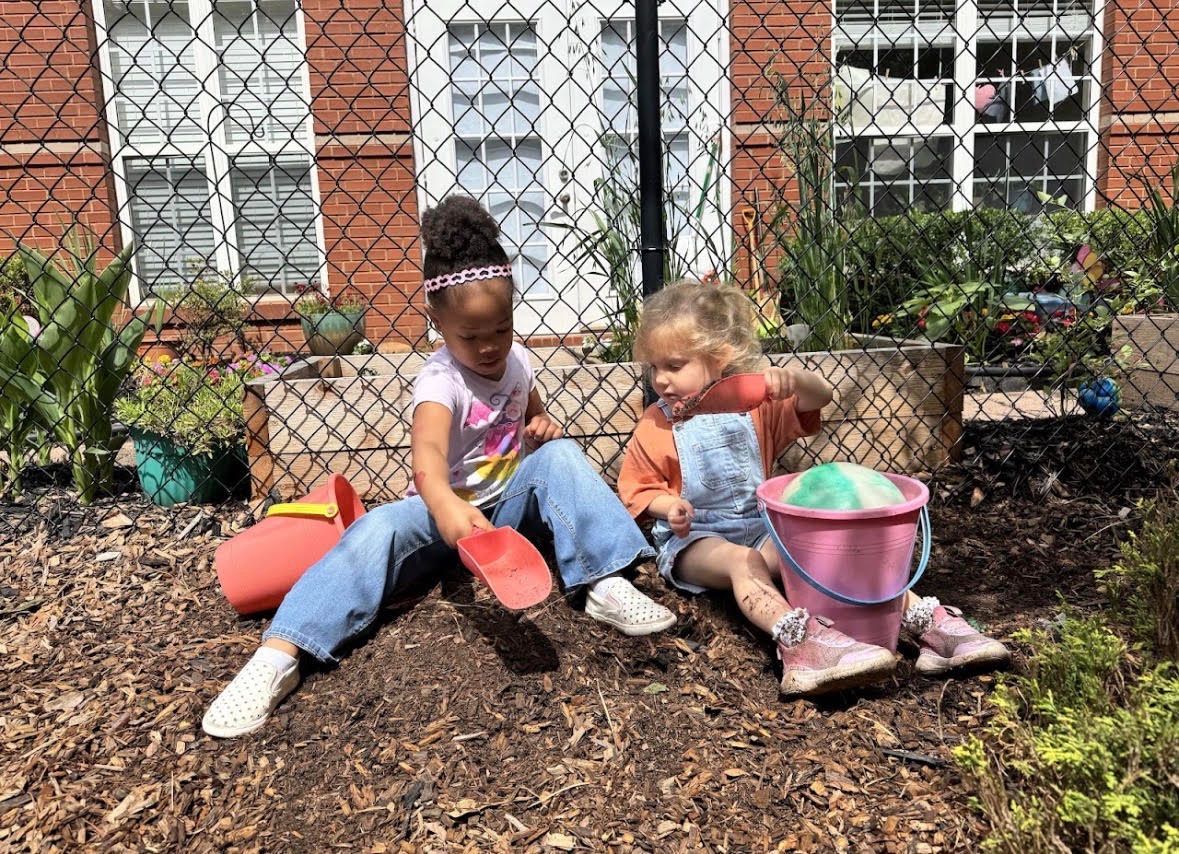
- Care of the Environment: From the Primary level, children share responsibility for maintaining their classroom—watering plants, dusting shelves, and preparing snacks for peers.
- Community Service: As children grow into Elementary, they lead student-driven service projects that extend beyond the classroom into the broader Alpharetta and North Fulton communities.
Experience Crabapple Montessori School in Action
These values are woven into the daily rhythm of our classrooms. The best way to understand how a Montessori environment supports your child’s emotional, social, and academic growth is to see it firsthand.
We invite you to
schedule a campus tour to learn more about our programs for children ages 18 months through 12 years.