Have you ever observed a primary classroom and wondered how five-year-olds are already writing full sentences, analyzing parts of speech, or reading with genuine confidence? To parents accustomed to traditional education, it can almost look like magic.
The secret isn't magic at all—it is a scientifically designed, step-by-step approach to language that honors a child’s natural physical and cognitive development.
Here is an inside look at how our Guides cultivate early literacy at Crabapple Montessori School, from a child's first days in Primary through their Elementary years.
1. Building the Spoken Foundation (Ages 3–4)
Dr. Maria Montessori identified that children under age six possess an absorbent mind, absorbing spoken language effortlessly from their surroundings. In our Primary classrooms, language work begins naturally through:
- Rich Vocabulary: Guides introduce precise terminology—naming specific botanical parts, geographical landforms, and animal classifications—rather than using simplified baby talk.
- Phonemic Awareness: We focus strictly on the phonetic sounds letters make rather than their names. Rather than teaching the alphabet song, a Guide introduces the sound "k" for "cat" instead of the letter name "C." This small distinction makes decoding and blending words significantly easier when reading begins.
2. Writing Before Reading: The Tactile Connection
In traditional settings, children are often asked to hold a pencil and copy letters before their hand muscles are fully developed. Montessori flips this sequence: children express their thoughts in writing before they physically handle a pencil or decode full books.
- Sandpaper Letters: Children trace textured letters with their fingers while repeating the sound, building muscle memory for letter formation long before gripping a pencil.
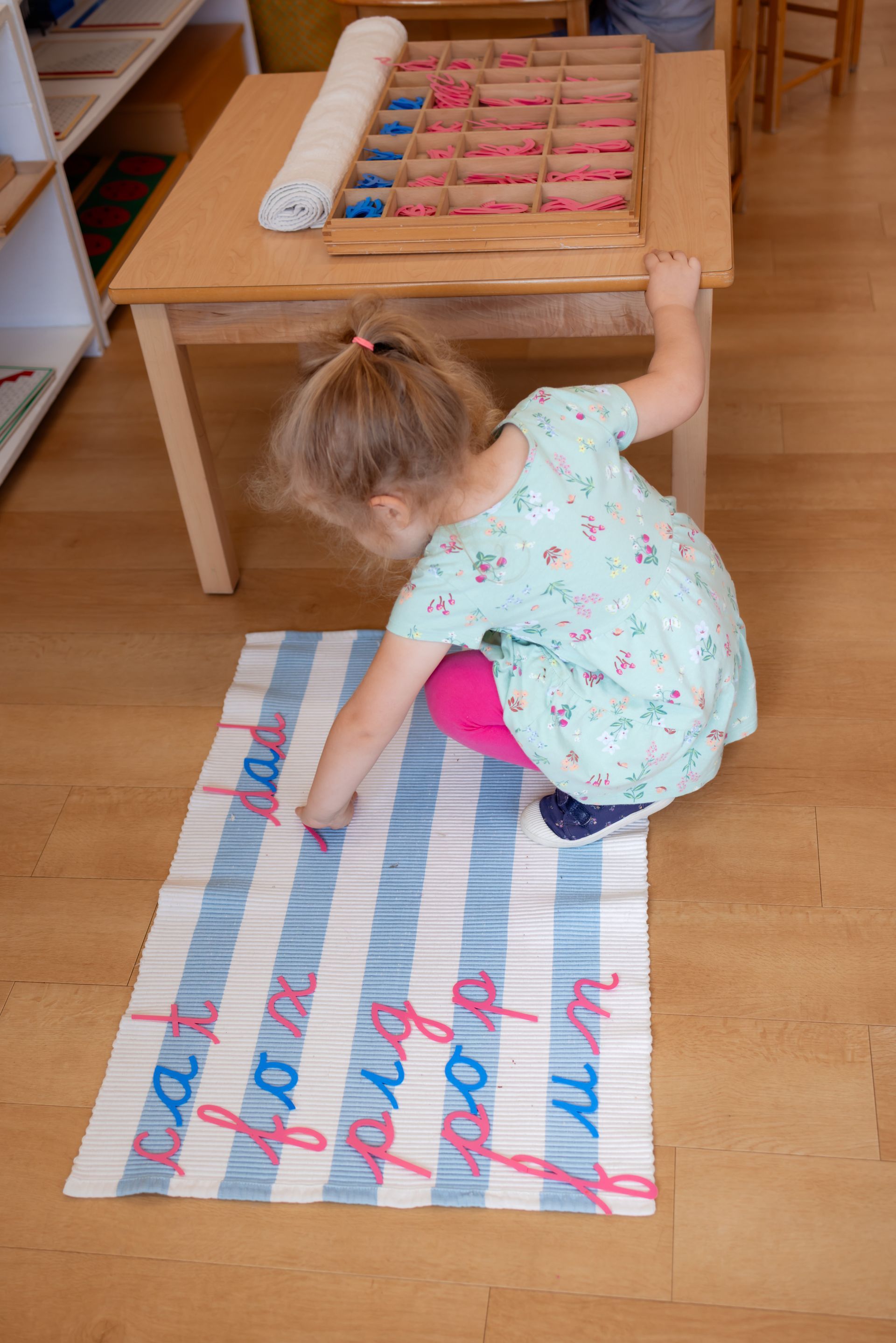
- The Moveable Alphabet: Once a child knows a handful of sounds, they use wooden letters to build words phonetically. A four-year-old can "write" stories by laying out letters on a mat (e.g., spelling "I luv mi mom"), separating the cognitive joy of composition from the physical effort of handwriting.
3. The Transition into Reading & Word Study
Because children have already built words sound-by-sound using the Moveable Alphabet, reading happens naturally as a process of reverse discovery.
- Object Boxes & Sound Cards: Children match tiny miniature objects (a pin, a pig, a pod) with physical label cards, isolating specific letter blends and vowel sounds.
- Specialized Reading Materials: As decoding progresses, Guides introduce carefully leveled readers (such as Miss Rhonda’s Readers or Bob Books). Note for current parents: We kindly ask families not to use these specific school series at home. When children memorize texts from home, it becomes harder for Guides to accurately evaluate their true decoding abilities.
4. Experiential Grammar & Sentence Analysis (Elementary)
Grammar in a Montessori classroom is never a drill of worksheets. It is an active, tactile exploration that grows with the child across our Primary and Elementary programs:
- Symbolic & Physical Grammar: Parts of speech are represented by distinct 3D wooden shapes (e.g., a large red sphere for a verb, symbolizing action). Children learn the "Function of Words" using interactive classroom items like our traditional grammar farm, where they label animals, physical actions, and descriptive details.
- Grammar Command Cards & Sentence Analysis: Elementary students physically act out direction cards, categorize complex sentences using colored wooden grammar boxes, and break down complex sentence structures—identifying predicate adjectives, clauses, and direct objects through hands-on materials.
Experience Language in Action
When language is taught in harmony with human development, children do not view reading and writing as a chore. They view it as an exciting key that unlocks the rest of their world.
Whether you are a prospective family exploring early childhood options or a current Crabapple family watching your child’s literacy blossom, we invite you to see this process in person.
Schedule a classroom observation and watch our Guides and students at work.