Our society is deeply familiar with the traditional image of a teacher: someone standing at the front of a room, passing along information, issuing instructions, and managing a classroom through direct oversight.
In a Montessori environment, however, the role of the adult is far more nuanced. The adult is there to observe, model, suggest, and facilitate. In a very real sense, the prepared environment and its materials teach—the adults serve as thoughtful partners in that journey.
For parents accustomed to traditional schooling, this shift can sometimes raise questions: How do children learn if the teacher isn’t actively teaching the whole class?
Traditional vs. Montessori Learning
Because the Montessori model approaches human development differently, the adults leading our environments bring a distinct set of skills, responsibilities, and observations to their daily work.
- The Traditional Approach: Historically, traditional models treat children like empty vessels waiting to be filled with information. The teacher sits at the center of the learning process, passing down knowledge, evaluating performance, and using external motivators—like grades, rewards, or corrective measures—to maintain focus. The child’s role is largely passive.
- The Montessori Approach: At Crabapple Montessori School, we see every child as a bundle of natural potential waiting to unfold. Learning happens most deeply when children are active participants in their own education. Rather than relying on external rewards, Montessori environments tap into a child’s intrinsic desire to explore, master concepts, and understand their world.
Through hands-on, self-correcting materials, children actively explore abstract concepts—from concrete math operations to language structures—at their own pace, building deep intellectual and emotional engagement without sitting through passive lectures.
What Does a Montessori Adult Do?
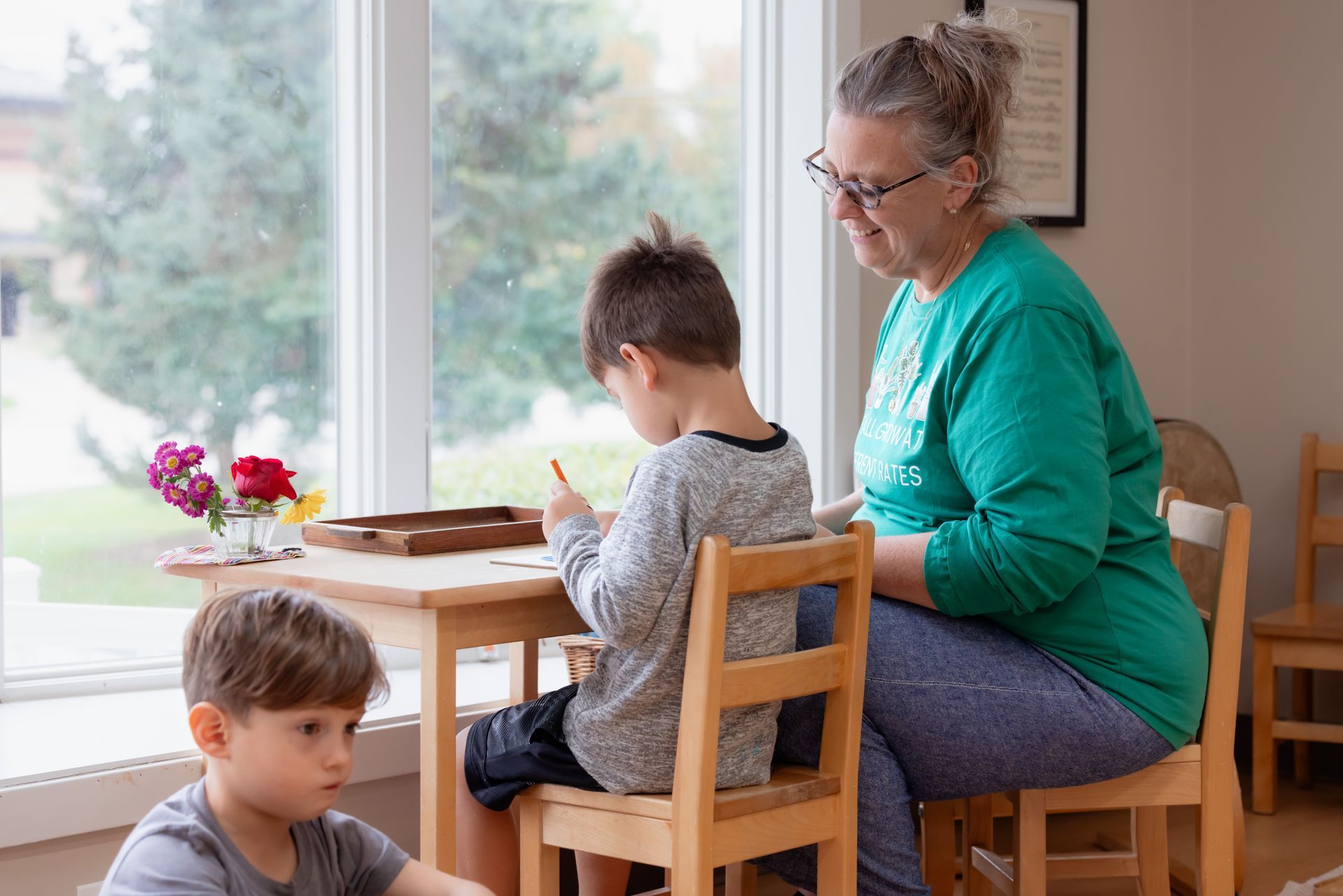
If you observe a Crabapple classroom, you might not spot the adult immediately. That is intentional. A Montessori Guide’s presence is calm, observant, and intentionally understated.
During the morning work period, you might see a Guide:
- Sitting quietly, observing the social and academic choices of the room to plan future lessons tailored to individual needs.
- Inviting a single child or a small group to a brief, precise lesson with a material.
- Offering quiet support or encouragement to a child working through a challenge independently.
When a Guide gives a lesson, the goal is rarely to simply hand over an answer or demonstrate a "trick" for solving a problem. Instead, the presentation is designed to spark curiosity and capture the child's imagination. The Guide offers just enough guidance for the child to return to the material independently—discovering mathematical proofs, scientific principles, or grammatical concepts through their own direct experience.
Why We Say "Guide" Instead of "Teacher"
This difference in purpose is why Dr. Maria Montessori chose the term Guide.
Montessori Guides do not stand at the front of a room directing every step. Instead, they prepare the environment, observe each child’s unique developmental pace, and clear the path for self-directed learning. Like a steady rudder on a ship, a Guide provides subtle course corrections when needed, allowing the child to navigate their own educational journey.
The result is a classroom full of independent, capable, and joyful learners who take true ownership of their progress.
Experience the Difference in Person
Reading about a Montessori classroom is one thing, but seeing it in action offers a completely different perspective. We warmly invite prospective and current families to
schedule a tour, walk through our quiet, purposeful learning environments, and observe how our Guides support a lifelong love of learning.