
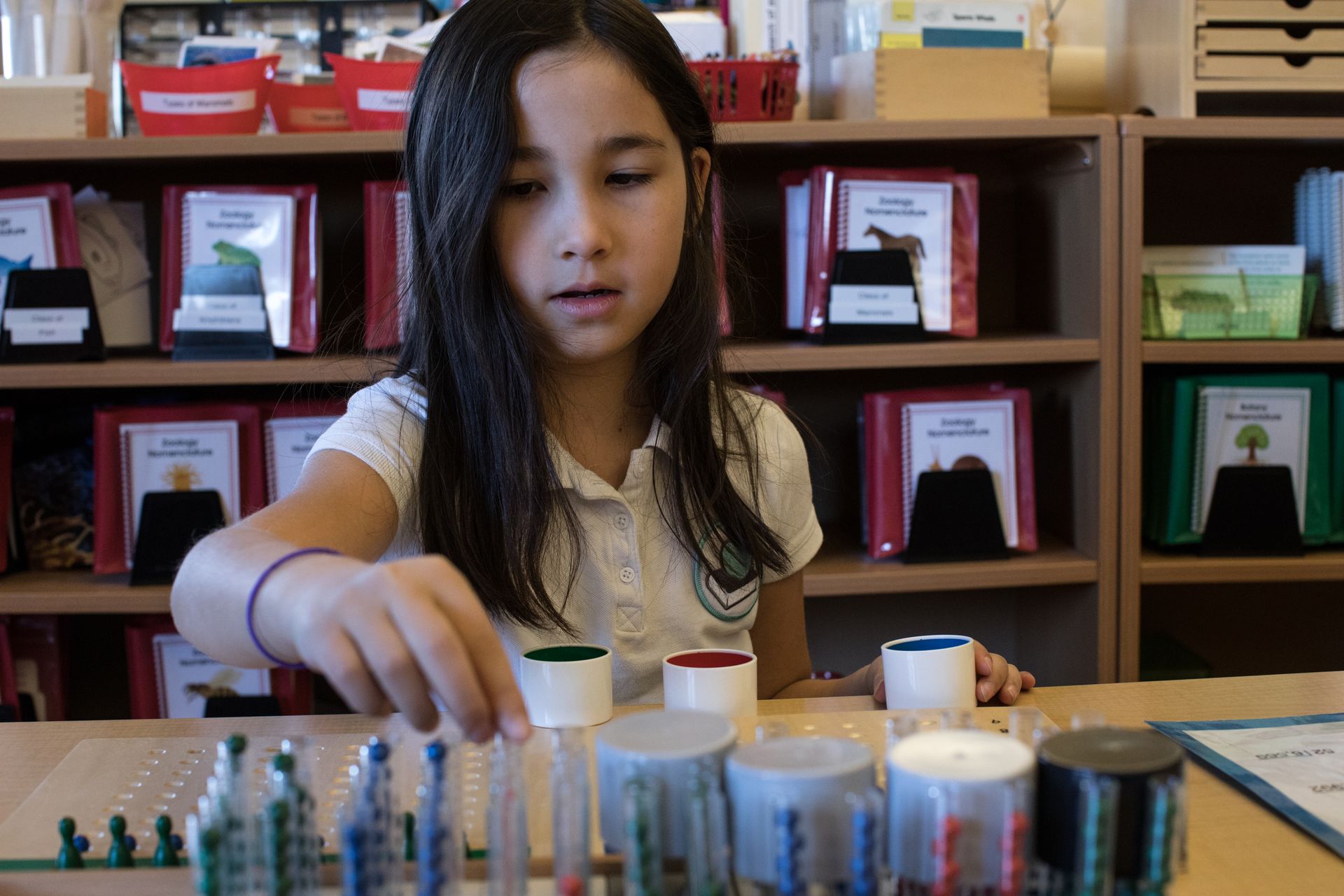
If you walk into the Elementary environment at Crabapple Montessori School during a work period, you might spot a student completely absorbed in an intricate setup of small color-coded boards, tiny cups, and dozens of glass test tubes filled with bright beads.
This material is formally known as the Racks and Tubes (or the Test Tube Division material). Typically introduced to children during the end of their Primary years (age 6) and used through Elementary, it is a gloriously detailed, tactile material. Adults who see the Racks and Tubes in action are almost always fascinated by how it transforms long division from an abstract chore into a visual, mechanical journey of discovery.
This is something far deeper than the rote memorization of algorithms many of us experienced with pencil and paper. While abstract recording is taught alongside it, having a concrete physical material gives our students a visual framework that makes mathematical concepts truly stick.
The Anatomy of the Material
The Racks and Tubes material is beautifully complex, featuring several precise components:
- Seven test tube racks: Three white racks represent the simple family (Units/ones are green beads, Tens are blue, Hundreds are red). This hierarchical pattern repeats with three gray racks representing the thousands family (Thousands, Ten Thousands, Hundred Thousands), and one final black rack with green beads representing Millions.
- Seven matching bowls: Colored externally to represent the numeric family and internally to match the specific bead value.
- Three pegboards: Wooden frames containing 81 holes where the beads are placed during calculation.
This specific color scheme—green for units, blue for tens, and red for hundreds—is a constant thread through the entire Montessori math curriculum. Your child will have already worked with this exact color coding in their Primary classroom when using the Stamp Game and the Bead Frame, allowing them to step up to complex division with a familiar visual vocabulary.
How it Works: Short Division
To see how this works in practice, let's take a typical problem a student might solve: 9,764 ÷ 4.
1. Setting Up the Workspace
Because the divisor (4) is a single digit, the student only needs to lay out one board (the green board representing units). They place four small green wooden figures, called skittles, along the top of the board to represent the divisor. Next, they count out the dividend using the beads and place them in the corresponding cups: 4 green unit beads, 6 blue ten beads, 7 red hundred beads, and 9 green thousand beads.
Consistently Recording the Work: At the Elementary level, independence and accountability go hand in hand. You will always see our students meticulously recording the problem and tracking their steps in their math grid notebooks as they manipulate the materials.
2. Fair and Even Distribution
Montessori math treats division as the ultimate exercise in fair sharing. The student begins with the highest place value—the Thousands cup. They distribute the 9 thousand-beads one by one beneath the four skittles. Each skittle receives 2 beads, leaving 1 leftover bead in the cup.
3. The Power of Exchanging
Because our students are already proficient in place-value exchanges, they know exactly what to do with the remainder. They return the lone thousand-bead to its tube and exchange it for 10 red hundred-beads, adding them to the Hundred cup.
Now possessing 17 hundred-beads, they repeat the distribution. Each skittle receives 4 hundreds, with 1 left over. That remaining hundred is exchanged for 10 tens, bringing the Tens cup to 16 blue beads. These distribute perfectly evenly (4 per skittle). Finally, the remaining 4 unit beads are handed out, leaving exactly 1 under each skittle.
4. Finding the Answer
In Montessori, the answer to a division problem is always what one single skittle receives. Looking down at a single column on their board, the student counts: 2 thousands, 4 hundreds, 4 tens, and 1 unit. They confidently record their final answer: 2,441.
Moving Into Long Division
When students progress to long division (dividing by two-, three-, or four-digit numbers), the Racks and Tubes material expands elegantly.
If a student tackles a problem like 71,326 ÷ 304, they will utilize three pegboards side-by-side (green, blue, and red) to match the three-digit divisor. Skittles are placed on each board to represent the hundreds, tens, and units of the divisor. The cups then shift and slide down the rows as the child works through the place values, tracking remainders and recording partial quotients on paper as they go.
Reading a manual on this process can sound complex to an adult, but to an Elementary child navigating it firsthand, it is an exhilarating puzzle. By engaging their hands to physically exchange and slide the beads, they are building structural scaffolding in the brain. They aren't just memorizing a trick to pass a test; they are truly understanding the mechanics of how numbers behave.
See it in Action at Crabapple
The absolute best way to appreciate the genius of the Montessori math curriculum is to watch it unfold in person. The focus, pride, and geometric order our Elementary students display while working through these massive equations is nothing short of wonderful.
If you are curious to see how our Elementary environment prepares your child for advanced academic success with joy and confidence, we welcome you to connect with us.
Want to learn more about the Montessori approach to mathematics? Schedule a campus visit!