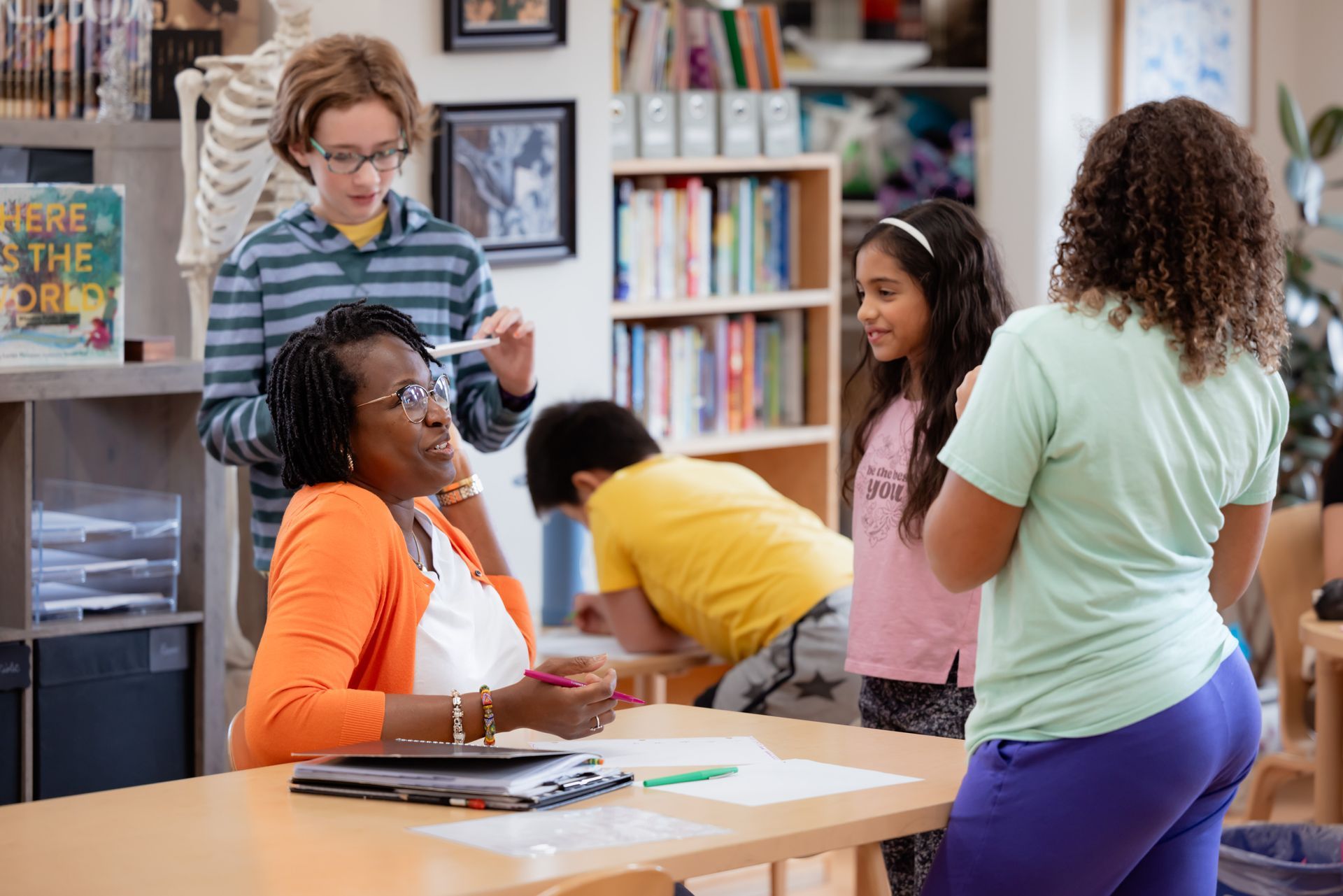
At the Elementary level (ages 6–12), a profound shift occurs in the child's development. Children move away from the sensory-driven "what" of the toddler and primary years, and become deeply captured by the how and why of the universe.
With this blossoming intellectual curiosity comes a natural drive to explore the world beyond their immediate family and the walls of the classroom. New research interests compel elementary-age students to explore anywhere and everywhere. Simultaneously, they are learning how to function as social beings within a larger society. To achieve this independence, our elementary children must acquire practical, real-world skills that cannot be fully mastered sitting at a desk.
One of the primary ways Montessori elementary programs help children develop these competencies is through a core practice known as “Going Out.” Dr. Maria Montessori developed this concept both literally and figuratively, recognizing that the door of the classroom must open safely into the wider world to satisfy the child's expanding psychological boundaries.
What is a Montessori "Going Out"?
Imagine a small cohort of two to four students collaborating on a research project in the classroom. Perhaps they have been studying ornithology, have exhausted the resources in our classroom library, and want to interview a local raptor rehabilitator to see falcons up close. Or perhaps a deep dive into historical architecture inspires them to visit a local historic home to analyze building materials from the 19th century.
Unlike an adult-driven field trip, a Going Out is born entirely from the children’s organic work. It is a targeted, small-group excursion designed to gather specific information that cannot be found within the school walls.
The Strategic Purpose Behind the Outing
This small-group experience directly serves the elementary child’s developmental need for independence, collaboration, and authentic experience.
1. Intellectual and Social Collaboration
Elementary children have a strong herd instinct; they want to work together, debate, and socialize. In preparing for an outing, students must practice advanced collaboration. Within their small groups, they share resources, make collective decisions, delegate responsibilities, and navigate interpersonal conflicts with the guidance of their elementary guide. They learn how to problem-solve respectfully before they ever step foot outside the school.
2. Functional Self-Discipline and Responsibility
A successful Going Out requires immense executive functioning. The children must organize their thoughts, their schedules, and each other. To execute their plan, they assume full responsibility for a wide range of logistical details, transforming abstract academic concepts into functional life skills:
- Writing professional emails or letters to request appointments.
- Making phone calls to speak politely with adults in the professional world.
- Mapping out routes, reading schedules, and calculating travel times.
- Budgeting for admission fees, supplies, or public transportation costs.
- Writing timely thank-you acknowledgments following their visit.
3. Grace and Courtesy in Society
Before departing, children receive targeted "mini-lessons" on social decorum tailored to their destination. They learn how to conduct an interview, how to actively listen to an expert, how to pay an admission fee, and how to respect the physical boundaries of a museum, laboratory, or public library. These experiences build true social confidence, showing children exactly what is required to enter and contribute to society gracefully.
How "Going Out" Differs from a Traditional Field Trip
While traditional school field trips are pleasant group experiences, they function fundamentally differently than a Montessori Going Out. A standard field trip is typically conceived, organized, and scheduled entirely by adults for an entire classroom or grade level, with the primary goal of general enrichment or a recreational reward. In stark contrast, a Montessori Going Out is a targeted, small-group excursion involving only two to four self-selected children. It is born organically from the children's own research, and they assume full responsibility for researching the destination, coordinating the schedules, and directing the logistics. While adults participate as passive safety monitors, the children remain the directors of the experience, turning what could be a passive outing into an active masterclass in executive functioning and real-world problem-solving.
A Collaborative Community Effort
A successful Going Out program relies heavily on a supportive relationship between the school and our parent community. When parents volunteer to serve as a driver for a Going Out, the dynamic is uniquely respectful of the child’s autonomy.
Unlike a typical chaperone who takes charge, a Montessori "Going Out" driver deliberately practices adult self-restraint. The driver relies on the children to provide directions, identify the correct parking area, and check in at the front desk. If the children miscalculated the venue's operating hours and arrive to find the doors locked, the driver does not step in to solve the problem; instead, they wait patiently while the children consult their notes and determine their next steps. This framework allows children to experience the natural consequences of their planning in a safe, controlled environment.
Bridging the Concept at Home
The empowering spirit of Going Out can easily be integrated into your family’s weekend and evening routines. You can encourage ownership by involving your elementary child in the logistical planning of everyday household tasks:
- The Grocery Excursion: Invite your child to sit down with the weekly menu plan, analyze the grocery list, estimate the total cost based on a budget, gather the reusable bags, and navigate the aisles efficiently at the store.
- The Library Research Quest: If a weekend hike sparks a sudden curiosity about local geology or mushroom identification, encourage your child to find the hours of your local public library, locate the phone number to call ahead, and speak directly with the librarian to reserve the necessary field guides.
Nurturing Capable Global Citizens
At Crabapple Montessori School, we recognize that children are capable of extraordinary responsibility when given the proper trust, structure, and preparation. By allowing our elementary students to step beyond the classroom door to answer their own questions, we honor their vast potential and give them the keys to unlock the world. This deliberate process satisfies their academic curiosity while cultivating the confident, resilient, and proactive citizenship our world needs.
Witness Our Classrooms in Action
The unique independence, focus, and maturity of a Montessori elementary community is best understood by seeing it live. We invite prospective families to
tour our campus, observe our mixed-age learning environments, and meet our dedicated leadership and faculty.